

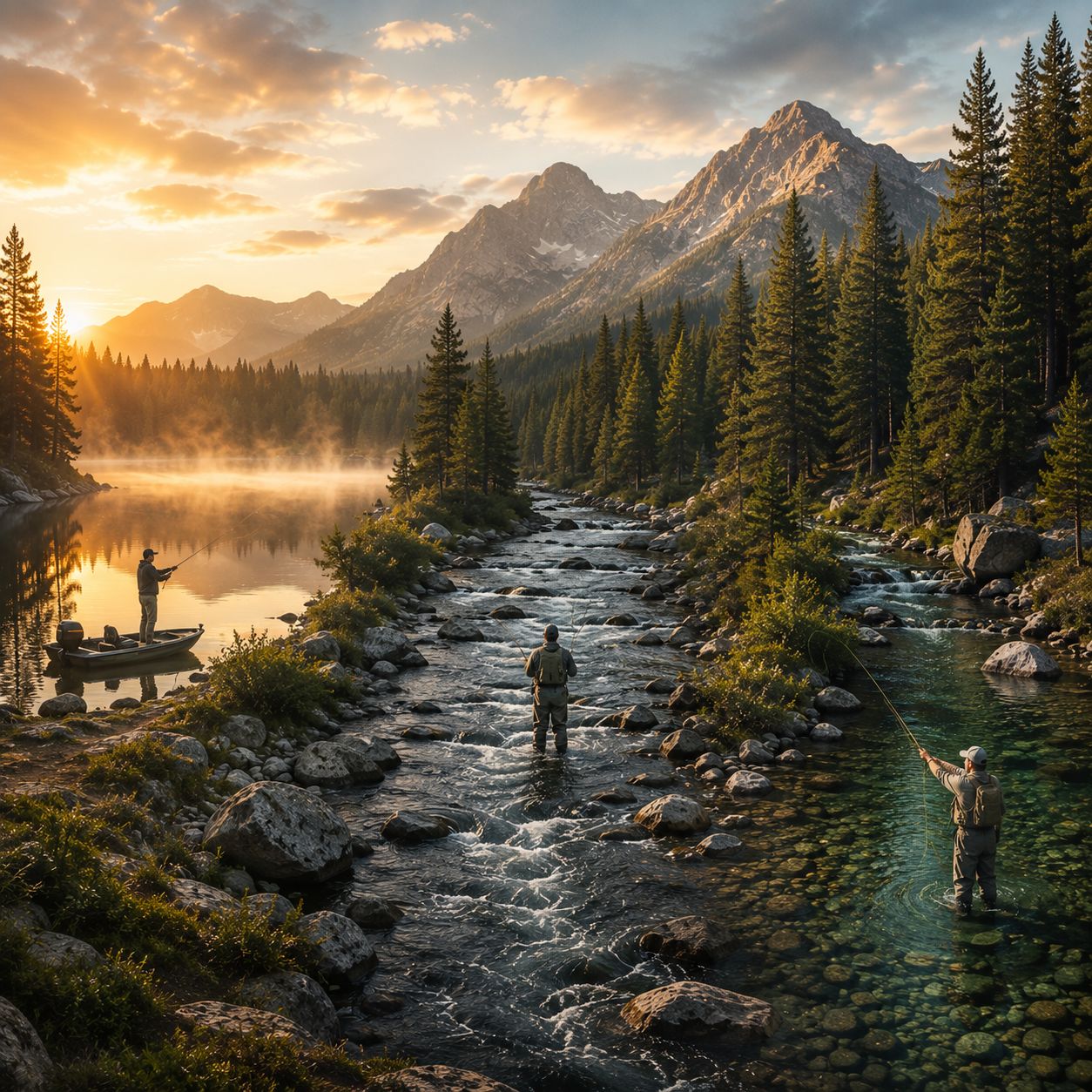
Fishing can look remarkably different depending on where you go, what you hope to catch, and how you like to spend your time outdoors.
For one angler, the perfect morning means casting along a quiet lake in search of bass. For another, it means following a cold mountain stream looking for trout. Others are drawn to the rhythm and technique of fly fishing, where presentation and casting become part of the experience.
There is no single “best” style of fishing.
The better question is: Which style fits you?
If you are new to fishing—or simply interested in trying something different—understanding the character of bass fishing, trout fishing, and fly fishing can help you decide where to start.
Bass Fishing: Active, Accessible and Full of Variety
Bass fishing is one of the most recognizable forms of freshwater fishing in North America.
Largemouth and smallmouth bass can be found across a wide variety of lakes, reservoirs, rivers, and ponds, making bass fishing accessible to anglers in many regions.
But accessibility is only part of its appeal.
Bass fishing can be highly active. Instead of placing a bait in the water and waiting, anglers often make repeated casts while exploring different structures and depths.
A typical day might involve fishing around:
- Weed lines
- Fallen trees
- Docks
- Rocky shorelines
- Points and drop-offs
- Shallow vegetation
- Deeper structure
Finding the fish becomes part of the challenge.
What Bass Fishing Feels Like
Bass fishing often has a sense of constant experimentation.
Cast toward a dock.
Try the edge of some vegetation.
Change your lure.
Move farther down the shoreline.
Try deeper water.
Then start again.
That makes bass fishing particularly appealing to people who enjoy staying active and making decisions throughout the day.
Who Might Enjoy Bass Fishing?
Bass fishing may suit you if you enjoy:
- Frequent casting
- Exploring different parts of a lake
- Experimenting with lures and techniques
- Fishing from both shore and boat
- A balance between relaxation and activity
- Learning how fish relate to underwater structure
It can also provide an approachable introduction to freshwater fishing because you do not necessarily need a complicated setup to begin.
A rod, reel, a few suitable lures, and accessible water can be enough for a simple day of fishing.
Trout Fishing: Follow the Cold Water
Trout fishing often takes anglers into very different environments.
Depending on the region and species, trout may be found in cold rivers, mountain streams, lakes, and reservoirs.
For many anglers, the setting is a major part of the attraction.
Imagine clear moving water, rocky banks, forested valleys, and mountain landscapes. Reaching a productive stretch of trout water can sometimes involve hiking, walking along riverbanks, or moving carefully between pools.
The fishing and the landscape become part of the same experience.
Reading a River
One of the interesting aspects of trout fishing is learning to understand moving water.
A river may look like one continuous flow to someone walking past it. An angler begins noticing smaller details.
A deeper pool behind a rock.
A current seam where fast and slow water meet.
A shaded bank.
A quiet pocket behind an obstruction.
These differences can influence where trout hold and feed.
Over time, anglers begin looking at rivers differently.
Instead of simply seeing water, they start seeing possibilities.
Who Might Enjoy Trout Fishing?
Trout fishing may appeal to you if you enjoy:
- Rivers and mountain environments
- Exploring new stretches of water
- Hiking as part of a fishing trip
- Reading currents and natural structure
- Smaller, quieter fishing locations
- Combining fishing with outdoor exploration
For some people, catching a trout is only part of the reward.
The walk to the river, the sound of moving water, and the landscape surrounding the fishing spot can be equally memorable.
What About Fly Fishing?
This is where an important distinction needs to be made.
Bass and trout describe fish. Fly fishing describes a fishing method.
You can fly fish for trout, but you can also fly fish for bass and many other species.
That means “trout fishing” and “fly fishing” are not opposites.
Instead, fly fishing is a particular approach that many anglers strongly associate with trout streams and rivers.
How Fly Fishing Is Different
In many conventional fishing setups, the weight of the lure or sinker helps carry the line during a cast.
Fly fishing works differently.
The fly itself is often extremely light, so the weighted fly line helps deliver it toward the target.
This creates the distinctive casting motion commonly associated with fly fishing.
Artificial flies can imitate insects and other food sources, and anglers often pay close attention to how those flies move naturally through or across the water.
As a result, fly fishing can involve considerable attention to:
- Casting
- Presentation
- Current
- Insect activity
- Water conditions
- Fish behavior
It can feel technical at first, but that learning process is part of the attraction for many anglers.
The Rhythm of Fly Fishing
Fly fishing has a distinctive pace.
You may spend time observing the water before making a cast.
Then comes the cast itself.
The line moves through the air.
The fly lands.
You follow its drift.
Then you retrieve the line and begin again.
For some anglers, that rhythm becomes almost as important as catching fish.
A successful trip does not always need to involve large numbers of fish. Improving a cast, finding a beautiful section of river, or getting one good presentation can make the day worthwhile.
Who Might Enjoy Fly Fishing?
Fly fishing could be a good match if you enjoy:
- Learning technique
- Precise casting
- Observing small details
- Rivers and moving water
- A slower, deliberate approach
- Continually improving a skill
- Spending time immersed in the environment
There can be a learning curve, so beginners should not expect everything to feel natural immediately.
That is normal.
Much of the satisfaction comes from gradually becoming more comfortable with the equipment, cast, and water.
Bass vs. Trout vs. Fly Fishing
The easiest way to understand the differences is to think about the experience each one can provide.
| Bass Fishing | Trout Fishing | Fly Fishing | |
|---|---|---|---|
| What it describes | Target species | Target species/group | Fishing method |
| Common environment | Lakes, ponds, reservoirs, rivers | Rivers, streams, lakes | Often rivers/streams, but many waters |
| Typical pace | Active | Exploratory | Deliberate |
| Casting | Frequent | Varies by method | Technique-focused |
| Mobility | Moderate to high | Often high | Moderate to high |
| Learning focus | Structure and lure selection | Water and fish location | Casting and presentation |
| Outdoor character | Lake life | River/wilderness | Technique/nature |
| Good for beginners? | Generally approachable | Yes, depending on location | Yes, with more technique to learn |
These are broad descriptions rather than strict rules.
Bass fishing can be peaceful.
Trout fishing can be highly technical.
Fly fishing can be fast and active.
Your experience depends on the water, conditions, equipment, species, and your own approach.
Choose Bass Fishing If…
You like the idea of arriving at a lake and actively searching for fish.
You enjoy trying different lures, changing locations, and making lots of casts.
You want something that can work from a shoreline, dock, kayak, or boat.
Bass fishing can provide a good balance between accessibility, strategy, and action.
Choose Trout Fishing If…
The location matters almost as much to you as the catch.
You enjoy mountain streams, rivers, forests, hiking, and exploring.
You like learning to read moving water and finding small places where fish may be holding.
Trout fishing combines fishing with exploration particularly well.
Try Fly Fishing If…
You are interested in the craft of fishing itself.
Casting technique sounds interesting rather than frustrating.
You enjoy paying attention to current, presentation, insects, and small changes in the environment.
Fly fishing rewards patience and practice.
For many anglers, learning becomes part of the experience rather than something that happens before the experience begins.
You Do Not Have to Choose Just One
Fishing styles are not identities you have to commit to permanently.
A bass angler can spend a weekend learning to fly fish.
Someone who normally fishes mountain streams can enjoy an afternoon casting from a lake dock.
A fly angler can target bass.
And someone who starts with one method may discover an entirely different kind of fishing a few years later.
Trying different styles can actually improve your overall understanding of fishing.
Bass fishing can teach you about structure.
Trout fishing can teach you to read water.
Fly fishing can sharpen your understanding of presentation.
Each provides a different perspective.
Start With the Water Around You
If you are completely new to fishing, you do not necessarily need to decide which style sounds the most impressive.
Start by looking at what is accessible.
Do you have lakes nearby?
Bass fishing may be a natural starting point.
Do you live close to cold rivers or stocked trout streams?
Explore trout fishing.
Is there an active fly-fishing community or accessible river nearby?
Consider learning the basics of fly casting.
The fishing you can realistically do is often more valuable than the fishing you imagine doing someday.
A nearby lake that you can visit regularly may teach you far more than a famous river you can reach once every few years.
Your Fishing Style Will Probably Change
The way you fish today may not be the way you fish five years from now.
Beginners often focus heavily on catching fish.
With experience, other parts of the activity may become more important.
Some anglers begin appreciating quieter water.
Others become interested in exploring remote locations.
Some become fascinated by technique.
Others discover that their favorite part of fishing is simply spending an early morning outside.
That evolution is part of the experience.
There is always another species to understand, another technique to learn, or another stretch of water to explore.
Find the Style That Makes You Want to Return
The best fishing style is ultimately the one that makes you look forward to getting back on the water.
Maybe that means working a lure along the edge of a bass lake.
Maybe it means following a mountain stream through the forest looking for trout.
Maybe it means standing waist-deep in a river, working on the same fly cast again and again.
Or perhaps your ideal fishing day includes a little of everything.
You do not need to fit neatly into one category.
Explore different water. Learn different techniques. Pay attention to what you enjoy—not simply what produces the biggest catch.
Because finding your fishing style is less about choosing a label and more about discovering how you like to spend your time on the water.